

An employee describes a problem. The manager sets aside distractions, asks questions, and listens attentively. The conversation appears constructive.
However, the employee returns to work facing the same obstacle and remains uncertain about next steps.
This is an illustrative example, not a specific case. It raises an important leadership question: when we say we have listened, what commitment have we made?
Listening is important. Employees deserve attention before a manager offers solutions. Some conversations require understanding, not intervention. However, when a work problem requires a decision, support, or escalation, a thoughtful conversation is only part of the responsibility.
The key measure is not whether the manager appeared concerned, but whether both parties understand the next step.
What the evidence can—and cannot—tell us
The 2025 NHS Staff Survey offers a useful, bounded example. In the weighted national results for NHS trusts in England, 72.65% agreed or strongly agreed that their immediate manager was interested in listening when they described challenges. For the separate statement that their manager took effective action to help with problems, the figure was 68.08%.[1]
That is a difference of 4.57 percentage points, calculated from the publisher’s full-precision values before rounding. It is a descriptive comparison between two survey items, not a measure of how many individual employees were listened to and then left without help.
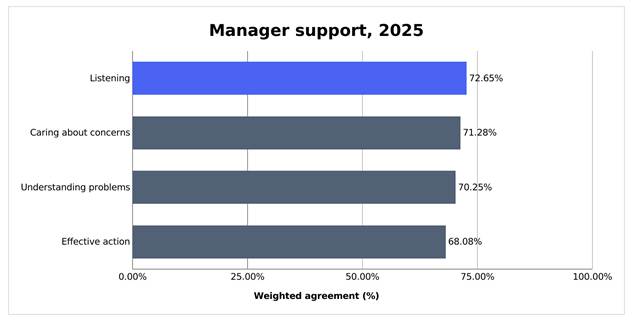
Figure 1. Separate measures of manager support, NHS Staff Survey 2025. Weighted agreement among valid responses in NHS trusts in England: listening 72.65%; caring about concerns 71.28%; understanding problems 70.25%; effective action 68.08%. Unweighted valid-item bases range from 746,019 to 746,940. These are separate questions, not stages in a respondent funnel. Source: detailed national results, YOUR MANAGERS Q9, national row, Q9f–Q9i.[1]
One positive finding: more than two-thirds of valid respondents agreed with each statement. The evidence does not suggest that managers are universally inattentive or ineffective.
It also does not justify treating listening and action as interchangeable. The survey questions address different experiences, and staff rated them differently.
The survey does not explain the reasons behind the results. It does not indicate whether a manager failed to act, whether action was within their authority, or whether the employee was informed of any attempts. It also does not show whether a specific follow-up process would improve outcomes.
These are weighted, self-reported results from a specific healthcare workforce in England—not a benchmark for every employer. Each item has its own valid-response base. Nonresponse remains a limitation, and aggregate percentages cannot establish individual pathways or causation.[2][3]
The practical takeaway is a question for local review: are we providing attention without clarifying the next step?
Ask what help is needed before promising action
Follow-through should not become an excuse for managers to take over.
An employee may need space to think aloud, assistance evaluating options, a decision beyond their authority, or intervention on an external barrier. These are distinct needs. Quickly solving the wrong problem is not better leadership than leaving the right problem unresolved.
A useful question is: “Would it help most for me to listen, work through options with you, or take something forward?”
That does not remove the manager’s responsibilities. Safety, misconduct, discrimination, and other serious concerns may require action through established procedures, regardless of how informally the conversation began. A manager should explain those boundaries rather than promise confidentiality or discretion they cannot provide.
For routine work problems, agreeing on the type of help needed gives the conversation purpose and preserves the employee’s agency. Support should enable employees to do their work, not shift every decision to the manager.
Make the next step visible
“Leave it with me” may sound reassuring, but it gives the employee little information.
What will be done? Who will do it? When will they hear back? What happens if the manager cannot resolve it?
A stronger close might be: “I will ask the scheduling lead whether we can change the coverage arrangement. I cannot promise approval. I will update you on Friday, even if I am still waiting for a decision.”
This example is a suggested practice, not a survey finding. Its value lies in the clarity of commitment: a specific action, a responsible party, and a defined update. The promise is not a guaranteed outcome, but assurance that the issue will not be ignored.
Keep records proportionate. A routine issue may require only a brief, properly stored note. Handle sensitive concerns through the appropriate confidential process, not a shared tracker. The goal is reliable support, not additional administrative burden.
Do not confuse follow-through with saying yes
Sometimes you can’t approve the request. A budget is constrained. A policy applies. Another team owns the decision. The proposed change would solve one person’s problem by creating an unfair burden for someone else.
These constraints are real and should be explained but not used to end the conversation prematurely.
A clear response distinguishes what the manager can decide, what must be escalated, and what is not available. Where possible, it also identifies an alternative. If no workable alternative exists, an honest explanation is more useful than an indefinite promise to “look into it.”
Similarly, forwarding an issue does not resolve the employee’s concern. Escalation may be appropriate, but someone must remain responsible for updates. If a decision is delayed, communicate this. If the original commitment was unrealistic, clarify and reset expectations.
A manager should not consider an issue resolved simply because their own task is complete. The employee may still be dealing with the original obstacle.
Check whether the response helped
An action can be completed without being effective.
A new instruction may be issued, but conflicting priorities can persist. Access may be granted, but not to the necessary tool. A revised schedule may solve one issue while creating another.
The follow-up question is straightforward: “Did that help with the problem we discussed?”
The answer may be yes, partly, or no. Each answer is useful. It tells the manager whether to close the issue, adjust the response, or acknowledge a remaining constraint. It also gives the employee a chance to correct the manager’s understanding without restarting the whole conversation.
This does not require lengthy meetings. A brief agreed update is sufficient. What matters is addressing the original problem, not just confirming that an action took place.
A small commitment worth making
For the next work problem that needs follow-through, try closing the conversation with a shared understanding of:
- The problem: What are we trying to make easier, safer, or clearer?
- The next action: What will happen, and who owns it?
- The update: When will we reconnect, including if there is no decision yet?
- The check: How will we know whether the response helped?
This is an editorial aid, not a validated intervention or a replacement for formal procedures. Use it where helpful but avoid making every conversation a formality.
Listening gives someone room to explain their experience. Follow-through makes clear what the manager will do with what they have heard.
Good leadership requires both, along with the honesty to explain when the next step is clarification, escalation, or a decision the employee may not welcome.
The conversation should not end with vague assurances, but with a clear understanding that both parties can reference.
Continue the conversation
What helps your team keep commitments visible after a challenging conversation? Share your leadership questions or perspectives. Please do not include confidential employee, client, or employer information.
Sources
[1] NHS Staff Survey — 2025 detailed national results
[2] NHS Staff Survey — Technical Guide to the 2025 Staff Survey Data, Version 2
[3] NHS Staff Survey — 2025: A Guide to Understanding and Using Results
Data note: Figures come from the 2025 detailed national results workbook, YOUR MANAGERS Q9 sheet, national row 6, questions Q9f–Q9i. Agreement combines Agree and Strongly agree. These are separate weighted survey measures, not a sequence tracking individual respondents. Source [1] links to the national results page, where you can download the detailed spreadsheets.