

A useful performance review should provide more than a rating. It should identify a clear skill to practice, offer support, and include a discussion about progress.
The appraisal is complete. You have discussed feedback, recorded objectives, and submitted the form. What will the employee do differently upon returning to work?
This is the leadership question to consider.
A formal review allows you to recognize good work, clarify expectations, and have an honest discussion of progress. However, completing the conversation does not prove capability development. To assess growth, consider what the person will practice, who will support them, and when they will receive feedback.
Address the actual issue. If an employee needs to build confidence in presenting recommendations, setting a vague objective like “improve communication” is insufficient. Focus the discussion on the audience, the decision, specific challenges, and a safe opportunity to practice.
Interpret appraisal evidence without losing nuance
The 2025 NHS Staff Survey offers a useful example of why receipt and experience should remain separate questions. These national results concern NHS trusts in England, not employees across all industries or countries.[1][2]
Among valid answers to the appraisal-receipt question, 86.42% reported an appraisal, annual review, development review or Knowledge and Skills Framework review in the previous 12 months. The unweighted question base was 739,829 responses.[1]
The survey then asked recipients whether that review helped them do their job better. Among those with a valid answer, 26.01% said “Yes, definitely,” 47.27% said “Yes, to some extent,” and 26.72% said “No.” The unweighted base for that question was 636,449.[1]
The largest response was partial benefit. It would be wrong to describe everyone outside “definitely” as having received no value. It would also be wrong to subtract the definitely-helped share from the appraisal-receipt share and call the difference failed reviews. One question includes valid receipt-question respondents; the other includes only recipients answering a follow-up.[2]
The history does not support a story of appraisals collapsing, either. Receipt and all three definitely positive follow-ups were higher than in 2021. The definitely-helped-improve-work share rose from 20.41% in 2021 to 26.01% in 2025, while remaining close to 26.04% in 2024. The other follow-ups—clear objectives and feeling valued—were also slightly below their 2024 levels.[3]
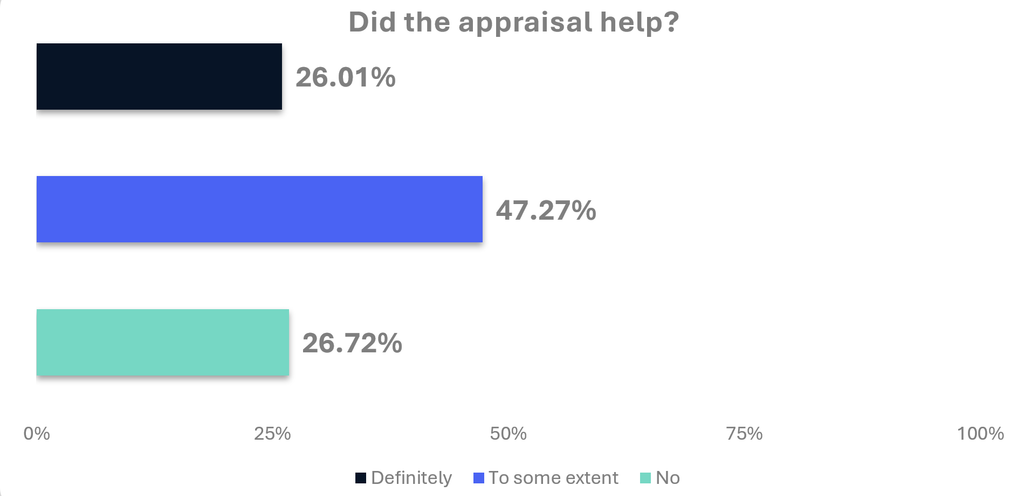
Did the appraisal help improve how staff did their job? NHS Staff Survey 2025, national trust-only results for England, Q23b. Weighted response shares among appraisal recipients with valid follow-up answers; unweighted base 636,449. Source: national detailed spreadsheet, “PERSONAL DEVELOPMENT Q23-24,” cells I6:K6; base L6. “Definitely” and “To some extent” both mean yes.[1][2]
These results reflect perceptions, not measured skill gains. They do not explain why a review was helpful, partly helpful, or unhelpful, nor can they determine if a specific follow-up would improve outcomes.
However, these results prompt leaders to ask a more practical question: after a review, what support does the employee receive?
Separate the assessment from the development commitment
An assessment evaluates work against expectations. A development commitment focuses on what the employee wants or needs to learn and the conditions for doing so. These conversations can be related but are not interchangeable.
Be clear about the nature of the conversation. If discussing a rating or required standard, state it directly. Do not present a formal performance requirement as an optional aspiration and avoid turning every development discussion into a judgment.
Invite the employee’s perspective. What would they like to handle more confidently? Where does their assessment differ from the manager’s? What work would help them prepare for their next responsibility?
The manager remains responsible for clarifying the role and its requirements. The employee should actively participate in choosing how to develop, rather than simply receiving a list of courses and deadlines.
Agree on practice, not just an intention
The following is editorial guidance for development conversations, not an intervention tested by the NHS survey. Keep it concise for practical use.
Name the capability in the work
Replace vague terms like “be more strategic” with specific descriptions both the employee and manager understand. For example: explain the trade-offs behind a recommendation before asking a team to decide.
Ask what the employee does well and where they seek support. A development goal should recognize existing strengths and not assume every challenge is a personal shortcoming. Issues like missing information, unclear authority, or excessive workload may require management action, not additional training.
Choose a real opportunity to practice
Identify a task where the employee can try the skill with an appropriate level of responsibility. This might be preparing a recommendation, leading part of a meeting, or explaining an analysis to someone outside their specialty.
Agree on the boundaries. What can the employee decide? What needs review before it is shared? Where would a mistake create a risk that calls for closer support?
Practice should not mean simply adding more work. Determine available time and adjust existing tasks as needed. If the opportunity isn’t feasible, communicate this and choose a realistic alternative instead of leaving an unsupported promise.
Make the manager’s commitment visible
Saying “ask if you need help” leaves the employee unsure what support is available. Be specific: review a draft, demonstrate a challenging task, arrange access to an experienced colleague, or provide opportunities to lead.
Agree on feedback and access. Who will observe the work? What will they look for? How will the employee get feedback they can use on the next attempt?
The employee commits to preparing, practicing, and raising challenges honestly. The manager commits to providing the agreed opportunity and support. Development should not become the employee’s responsibility solely when the manager controls the conditions.
Return to work and revise the plan
Schedule follow-up based on the practice opportunity, not just the next formal review. Discuss outcomes while the experience is still fresh for both parties.
Ask: What did you try? What was easier or harder than expected? What feedback helped? What would you do differently next time?
Also confirm whether the manager provided the promised support. If the opportunity was withdrawn or feedback wasn’t given, don’t interpret this as a lack of employee commitment. Instead, address the issue or update the agreement.
A development note both people can use
A brief shared note can make the next conversation more concrete. Use these prompts as a working aid, not as a formal assessment.
· Capability: What do I want to do better, and why does it matter in my work?
· Practice: Where will I try it, with what decision boundaries?
· Employee commitment: What will I prepare, attempt, and bring back for discussion?
· Manager commitment: What time, access, demonstration, or feedback will I provide?
· Return conversation: When will we look at the work, and what will we discuss?
For example, an analyst might practice explaining a recommendation in an internal planning meeting. The analyst prepares the trade-offs and requests feedback on the explanation. The manager reviews the draft in advance, protects preparation time, and discusses audience understanding afterward. This is a proposed agreement, not a client case or guaranteed outcome.
Such a note does not confirm that learning has occurred. During follow-up, review the work and consider the employee’s assessment. Distinguish between holding the conversation, completing the practice, and actual improvement. Do not assume improvement solely because the conversation took place.
What this evidence cannot tell your team
The NHS percentages are weighted to account for trust size and occupational mix; the response bases reported here are unweighted. They are not counts to multiply by the percentages. The national trust response rate was 49%, so nonresponse bias may still matter.[2][3]
Historical comparisons use the publisher’s reweighted series, not a fixed group of people followed over time. The briefing did not include historical item bases. No confidence intervals or significance tests were calculated for this article, and no respondent-level data were used.[2][3]
Use evidence to inform questions, not to diagnose your workforce. Local discussions may reveal issues such as unclear expectations, insufficient practice, delayed feedback, or goals the employee did not choose. These are areas to explore, not conclusions drawn from the survey.
Make the next conversation useful
Retain the appraisal if it serves a clear purpose. However, do not treat a completed review as a substitute for development. Before concluding the next conversation, ask the employee what they will practice and what support they expect from you. Clearly state your own commitment as well. People drive systems; the development plan should support the individual’s learning.ng. If you are working through a leadership or team-development question, start a conversation. Share the situation and what a useful next step would look like, without confidential employer, client, or employee details.