

A national survey shows where businesses say they use AI. It cannot tell you which workflow will improve your organization.
That distinction makes the Census Bureau’s Business Trends and Outlook Survey (BTOS) AI supplement useful. It provides a concrete starting point for investigating work—not a business case to borrow without testing.
Among companies whose employees used generative AI for work in the preceding six months, 85.4% reported using it to write or edit documents, emails, or communications. Searching for information or technical help was reported by 49.9%.[2]
Those findings make writing and information-heavy tasks worth examining. They do not establish that these tasks delivered the largest savings, produced acceptable work, or should be automated first.
The decision is narrower: which task in your own process is suitable for a controlled test, and what evidence would justify keeping the change?
Start with what the survey measures
The Census Bureau collected the supplemental AI questions from November 17, 2025, through February 8, 2026, and released the data on April 23, 2026. BTOS represents U.S. employer businesses, excluding farms.[1] These findings do not reflect business use in October 2026.
The collection period and the question recall period differ. Businesses answered at various points during collection; the question asked about their preceding six months. It did not ask only about work done between the start and end dates. article examines selected national estimates from the Census-published workbook. The data are weighted company-level survey estimates, not individual employee records or logs of completed work. Census collected and published the data; the contribution here is analysis and interpretation of those published estimates.
The workbook’s Question 10 asks: “In the last six months, what work-related tasks did this business’s employees use Generative AI to assist with?” The published questionnaire lists this as Question 32 and instructs respondents to select all that apply.[3]
Its denominator matters. These estimates describe companies reporting employee generative-AI use for work, not every U.S. business. A company could report multiple tasks. The responses overlap and do not represent slices of a total workload. The task-use pattern is a starting point, not a ranking of value
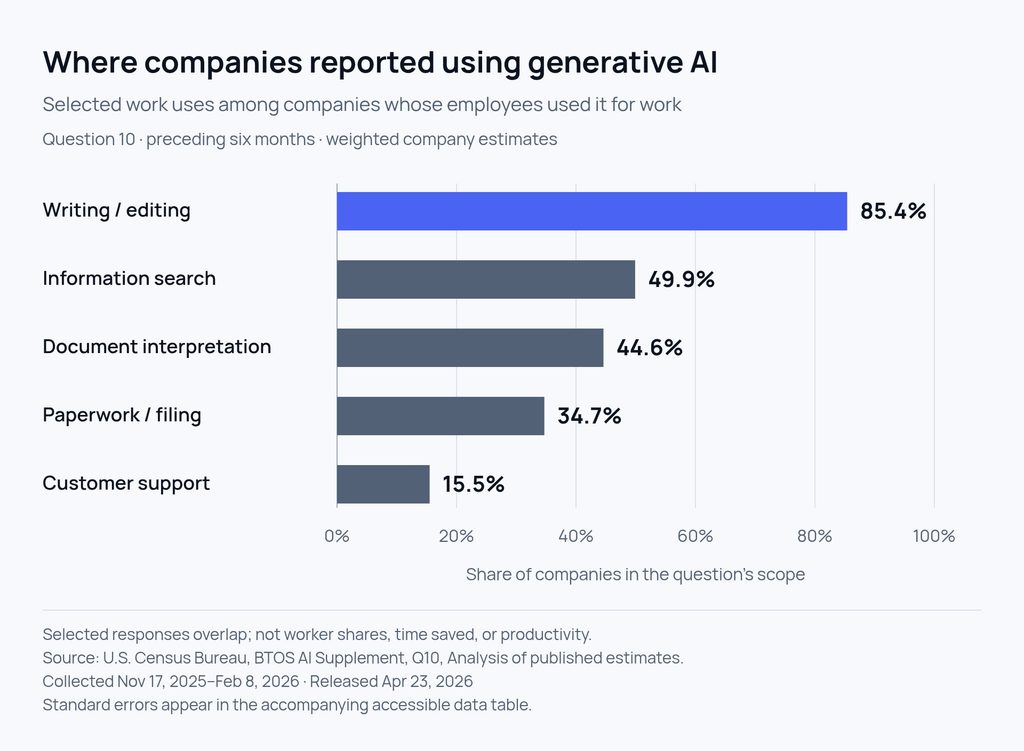
Selected reported uses among companies whose employees used generative AI for work in the preceding six months. Collection: November 17, 2025–February 8, 2026; release: April 23, 2026. Analysis of U.S. Census Bureau BTOS AI supplement national estimates. Selected responses overlap and are not exhaustive; they do not measure worker shares, task volumes, time saved, or productivity. Standard errors are provided in the table; no uncertainty intervals are plotted.[1][2]
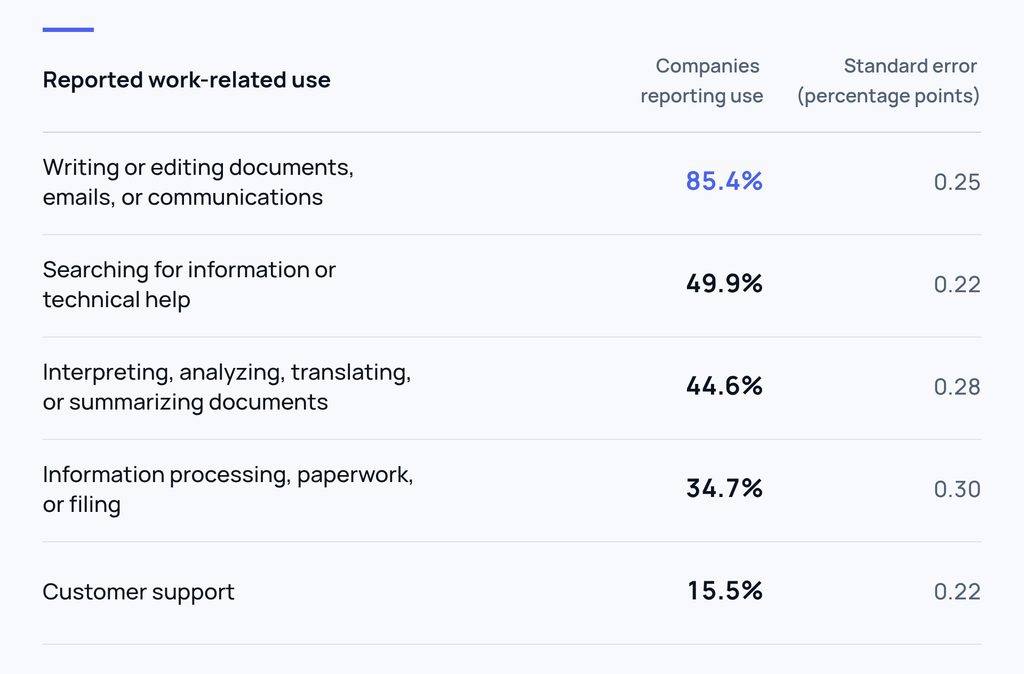
Source: U.S. Census Bureau, AI Supplement Table 2026, Question 10. Figures show national response estimates and corresponding standard errors.[2]
Writing and editing stand out in this selection. Document-related work appears in several response categories, but overlap prevents adding those percentages into a combined “document work” share. This selection also does not show all available response options.
The useful implication is to investigate the writing, search, and document tasks already in your process. Look for a specific point where assistance can be evaluated against a known standard. Do not interpret the longest bar as the largest opportunity without local evidence.
A lower reported-use percentage is not proof of lower value. Customer support can involve consequential commitments, permissions, and case context. This survey does not tell us why businesses chose a task, what safeguards they used, or how well the work was performed.
Keep uncertainty separate from the questions the survey cannot answer
The standard errors describe sampling uncertainty in the estimates. They are expressed in percentage points, not relative percentages or confidence intervals. The chart uses a zero-to-100% scale and direct labels; the table shows uncertainty without tiny error bars as a measure of operational risk.
Small standard errors do not resolve the more important limits for choosing a workflow.
The published task-use responses do not show how often employees used a tool, how much checking it required, or whether the work was accepted. They do not identify causal effects on productivity, cost, quality, or employment. They also do not show that companies choosing one task had better outcomes than those choosing another.
This article does not conduct formal between-category tests or interpret sector and state differences. The supplement’s respondent count and covariance needed for detailed comparisons are not established here. The overall BTOS sample description should not substitute for the number of businesses answering this supplemental question.
Use the estimates to frame a local question, not to supply the missing answer.
Turn a reported use into a testable task
A practical candidate is a permitted, reversible writing or document task with a qualified human reviewer. That is a proposed experiment, not a conclusion that writing is always the best first use case.
For example, a team could test drafting a short internal summary from an approved, nonsensitive source document. The model would propose the text. A reviewer would compare it with the original, correct it, and decide if it was usable. Nothing would be sent, published, or used to make a consequential decision automatically.
The task is suitable only if the team can answer four concrete questions:
· Is the source material permitted in the selected tool and environment?
· Can a reviewer determine what the correct output should contain?
· Is the current task frequent or burdensome enough to make improvement worth testing?
· Can the team return to the existing method without disrupting the wider process?
If the main difficulty is unreliable source material or no agreement on the required result, a draft generator won’t solve it. The earlier article, Before You Add AI, Decide What Actually Needs to Change, addresses that process-before-tool decision. Here, the next step is to make the evidence requirement specific to one task.
Measure accepted work, including the work that fails
Establish a baseline using comparable tasks and the same definition of acceptable output. Keep document complexity, reviewer expectations, and the people doing the work as comparable as possible. When feasible, randomly assign suitable tasks between existing and assisted methods to strengthen the comparison. If assignment is not random, record selection differences and do not present the result as a clean causal estimate.
Before starting, agree on the review window and evidence needed to decide. This survey does not provide guaranteed pilot duration, sample size, or expected return.
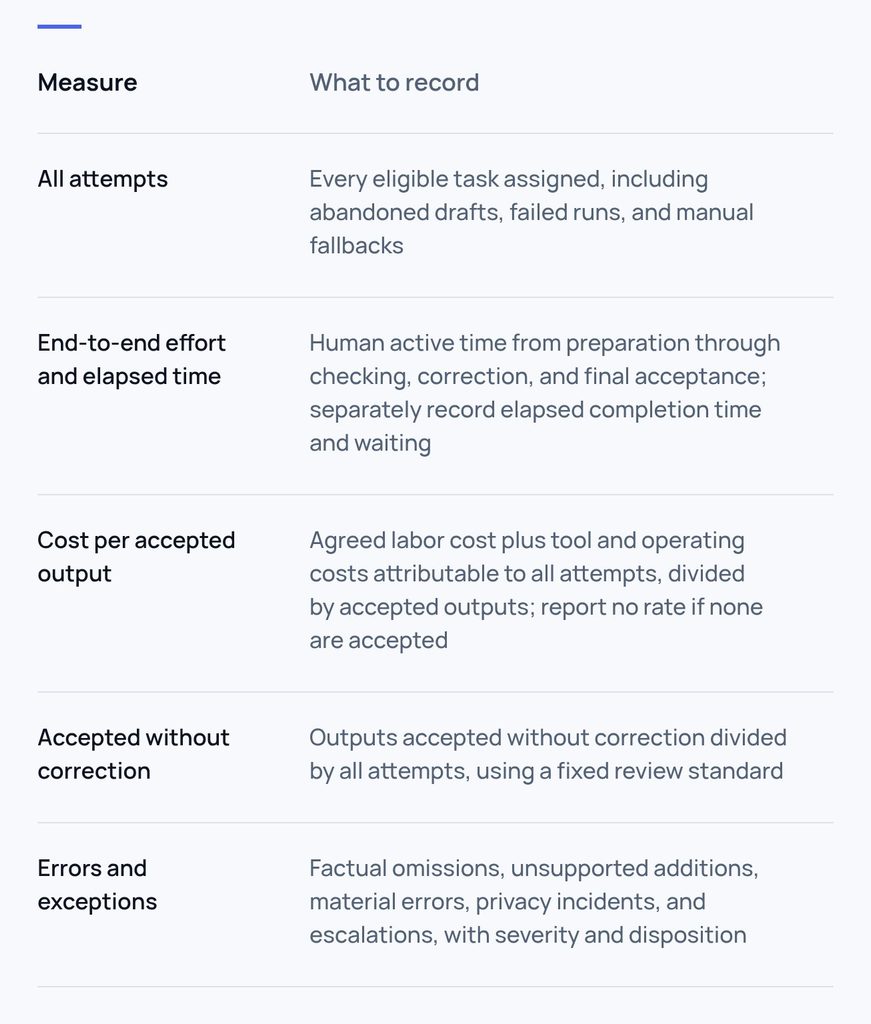
Keep acceptance and correction-free acceptance distinct. An output may be usable only after substantial repair. Counting it as accepted without recording that effort would hide the cost the test needs to reveal.
A shorter drafting step is not enough. If preparation and checking absorb the gain, the task may not improve. If a faster output contains a serious unsupported statement, the speed does not make it acceptable.
Assign one owner to review both benefits and failures. Set benefit and quality gates before seeing results: what improvement is meaningful for this workload, which errors are unacceptable, and what review effort can be sustained? Stop for sensitive-data exposure or unacceptable material error; investigate before resuming. Keep the existing method available.
Expand only when the observed local benefit meets the agreed gate without worse quality or unacceptable risk. If the comparison is too small or poorly matched to support a decision, gather better evidence or narrow the task. Do not treat an inconclusive demonstration as proof of success.
Use national evidence to choose a question—not borrow an outcome
The Census task-use estimates make one point concrete: writing, search, and document interpretation are reported uses worth investigating among companies already using generative AI for work. They do not establish which use is most valuable for a particular organization.
A useful first workflow is one where the business need is real, data use is permitted, the output can be checked, and the whole task can be measured. National evidence helps identify a candidate. Local evidence determines whether the change deserves to stay.
Sources
[1] U.S. Census Bureau — Business Trends and Outlook Survey Data Release — April 23, 2026
[2] U.S. Census Bureau — Business Trends and Outlook Survey data and AI supplement resources
[3] U.S. Census Bureau — BTOS questionnaire with AI supplement, revised July 23, 2025
Data note: Figures come from the National Response Estimates and National Standard Errors sheets, Question 10. Source [2] links to the Census resource page rather than directly to the workbook. Standard errors describe uncertainty in the survey estimates, not expected workflow performance.
Related reading
More articles are taking shape.